

Environment and Biodiversity
- Location:
world - Sponsor:
Bernard Cyna - Grant:
€6,000 awarded under the 2025 Student Solidarity Award
Project leader
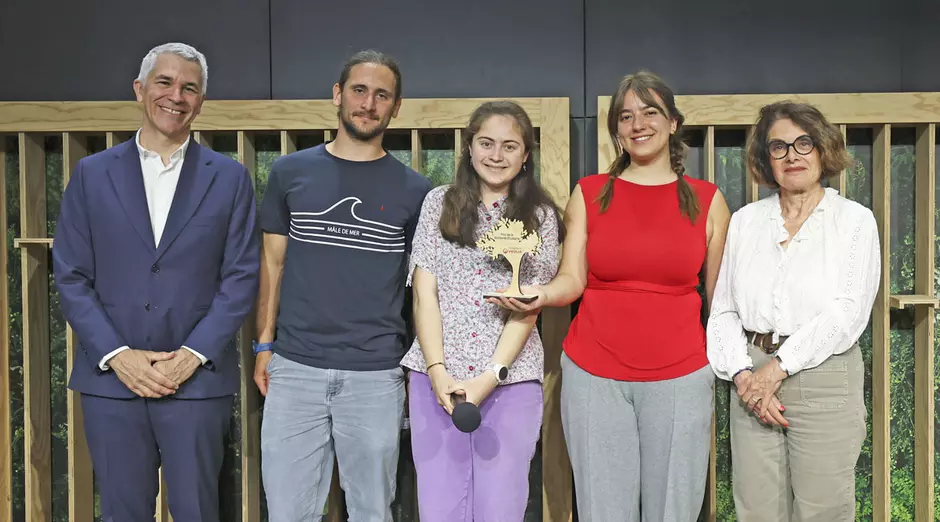
Just 2.0°C” brings together students from various universities and prestigious higher education institutions (ENS Ulm, ENS Lyon, ENS Paris-Saclay, Paris-Saclay University, University of Bordeaux, INSA Lyon). It aims to promote and support projects that combine interdisciplinary scientific research, cultural outreach, and citizen-led initiatives addressing climate change and human-induced environmental change. The organization is committed to spreading scientific culture and methodology to as many people as possible by making environmental data accessible, concrete, and understandable to everyone.
Six months of embedded research aboard a floating laboratory
The winning project of the 2025 Student Solidarity Prize, named "Sail to Sandwich" (S2S), is a sailing expedition to explore the South Atlantic and raise awareness among 6,000 students about the scientific process. It will set sail from La Rochelle aboard the Northabout, a sailing yacht configured as a low-carbon mobile laboratory. Four student-researchers and three professional sailors will navigate for six months toward the South Sandwich Islands, a hostile volcanic and glacial archipelago located between Patagonia and Antarctica. Throughout their ports of call (the Canary Islands, Cape Verde, the Falkland Islands, South Georgia, and Saint Helena), the multidisciplinary team will conduct research in volcanology, biology, physical geography, and the philosophy of science, specifically studying glacier melt, rising sea levels, and pollutant concentrations in seabirds.
Sharing science with schools and the general public
The grant awarded through the fondation Veolia Student Solidarity Award supports the acquisition of research equipment and the deployment of an extensive outreach campaign spanning two school years. This educational component will connect the ocean adventure to nearly 200 schools (from kindergarten to higher education, with a priority on rural areas and priority education networks - REP/REP+), reaching 6,000 students through logbooks and live video conferences from the ocean. For the general public, the expedition’s impact will extend ashore through the production of a documentary film, a popular science podcast series, an illustrated book, and interactive workshops at science festivals.